Design Partners
Two slots for regulated organizations ready to validate governed AI execution in their environment.
The Problem You Already Have
Your organization is deploying AI agents that take autonomous actions — executing workflows, accessing data, and making decisions that affect customers and operations.
Today, if a regulator, auditor, or internal risk team asks:
What did that agent know when it acted?
What was it authorized to do?
Can you prove it?
most organizations cannot answer with anything stronger than logs.
Regulatory reality
DORA already requires auditable, traceable digital operations in financial services. The EU AI Act is bringing staged obligations into force with major requirements for many high-risk AI systems arriving through 2026–2027. Auditability is the near-term pressure; AI-specific regulation adds tailwind.
Most AI governance tools on the market today observe what happened after the fact. Very few can reconstruct the decision boundary itself: what the agent knew, what it was authorized to do, and whether the evidence still holds together afterward.
That is the missing layer.
What We've Proven
AmplefAI is not a proposal. The governed execution stack is live and verified.
Governed cloud execution
A live agent on confidential cloud infrastructure executes through a governed boundary. No ungoverned execution path exists. Every action is authorized before execution, not logged afterward.
Decision-state binding
Before each action, the system captures what the agent knew (mission payload, context bundle, and governing policy state), hashes it, and binds it into the signed authorization path. After the fact, replay can verify that the captured snapshot matches the authorization record. The claim is not "we authorized this action." It is: "we authorized this action based on this exact knowledge state."
Fail-closed enforcement
Any failure at any step (policy evaluation, signing, snapshot capture, ledger write) results in deny. There is no fallback to ungoverned execution.
Tamper-detectable audit
The decision ledger is append-only and hash-linked. Deletion, modification, insertion, and reordering are all detectable. Every governed decision is recorded before execution.
Honest about scope
This is a runtime enforcement layer, not a compliance framework. It provides cryptographic control primitives that support specific regulatory control requirements. It does not replace risk management, lifecycle governance, or model explainability. Our regulatory mapping shows exactly what is covered, what is partially addressed, and what remains a gap.
Verified
Golden dispatch
schema-valid + replayed
154
GEI tests
current pass
344
Root tests
current pass
29
Enforcement invariants
11 GEI + 18 PCK
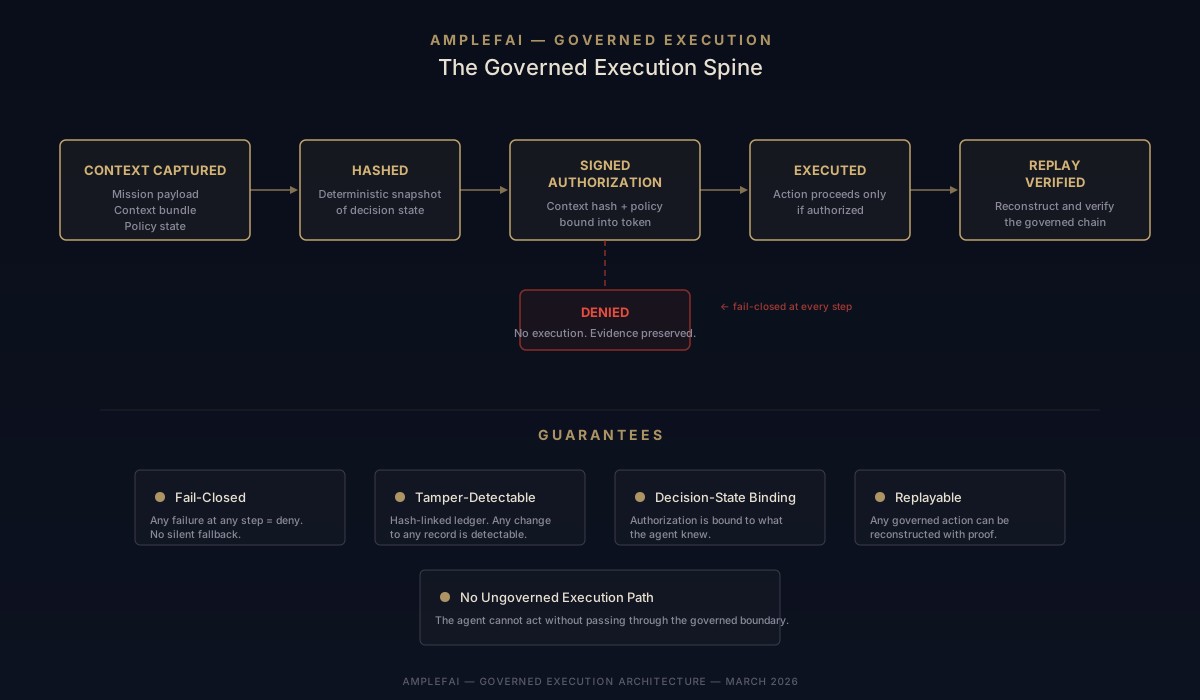
Governed execution spine — every action authorized before execution, every decision replayable after
The Ask
We are looking for two design partners — regulated organizations willing to validate this infrastructure in their environment.
What you get
- •Early access to the governed execution stack
- •Direct influence on the roadmap: your compliance and control requirements shape what we build next
- •A concrete technical proof point to support your DORA and EU AI Act readiness work
- •Architecture-level integration support from the team building and operating the system
What we need
- •A bounded pilot environment: one agent, one action class, governed through the spine
- •Periodic feedback sessions with your compliance and architecture teams
- •Honest feedback on what works, what doesn’t, and what’s missing
What this is not
This is an infrastructure validation partnership. You validate the primitive in your environment. We learn what production governance for autonomous AI actually requires. Both sides get a clearer answer to the same question:
Can you prove — after the fact, with cryptographic evidence — what your AI agent knew, what it was authorized to do, and what it actually did?
That is the question every regulated enterprise will eventually face. We'd rather explore the answer together.