Make autonomous AIgovernable.
AmplefAI is the evidence layer for governed agent execution. Authorize before execution. Preserve the evidence after.
Designed for regulated teams that need more than logs. Govern your agents, and you can finally let them run.
The Problem
AI is powerful.
But it's not accountable.
Every AI agent acting without governance is an unaudited employee with root access. It can do anything, and no one can prove what it did or why.
Answers
AI generated text. Humans reviewed everything. The risk was manageable. You could always undo a bad paragraph.
Actions
AI started calling APIs, writing code, sending emails. Mistakes became harder to catch and harder to reverse.
Autonomous
Agents operate end-to-end: deploying code, moving data, making decisions. Governance is no longer optional.
The organizations that win with agents won't be the ones that watched them. They'll be the ones that could prove control, and therefore granted autonomy.
For regulated teams, the near-term pressure is operational resilience, traceability, and accountable ICT risk controls. DORA is already here. AI-specific regulation adds tailwind. The evidence layer these regimes require does not yet exist in the current AI stack.
What's Missing
Watching isn't the same as controlling.
Most AI governance tools observe what happened. AmplefAI enforces what's allowed: in real time, before the action executes.
Why not just logs?
A log tells you "47 records were deleted." That's a record of what happened. AmplefAI provides "cryptographic proof it was authorized before it happened." That's the difference between a security camera and a lock.
Why not just policy engines?
Policy engines like OPA and Cedar decide yes or no. But a decision isn't enforcement. AmplefAI doesn't just decide. It binds every action to proof that it was allowed. The difference is between an opinion and a contract.
How It Works
Three questions.
Answered before every action.
Before any AI agent acts, AmplefAI answers three questions: Who authorized this? Does it follow the rules? And will we remember what happened?
Authority
Who authorized this action?
Every agent gets a time-limited credential that defines exactly what it can do, for how long, and under whose authority. When the job is done, the credential expires. No exceptions.
- Time-limited, auto-expiring permissions
- If it's not explicitly allowed, it's blocked
- Safe delegation between agents
- Cryptographically signed
Enforcement
Is this allowed?
Every action is checked against your policies before it happens. If it's not authorized, it's blocked. Every decision is recorded in a tamper-evident audit trail: not just what happened, but cryptographic evidence that it was allowed.
- Real-time policy enforcement
- Tamper-evident audit trail
- Custom rules for your business
- Stackable policies
Continuity
What gets remembered?
AI models get replaced. Agents get restarted. Vendors change. But your company's knowledge, policies, and operational history stay intact: versioned, protected, and always recoverable.
- Institutional memory that survives model changes
- Isolated scopes for different teams
- Full forensic replay
- Reconstruct any past decision
Your agents can change.
Your rules don't.
Answer all three questions, and autonomy stops being a risk decision. It becomes a budget you can spend.
Not a Whitepaper
First replayable
governed dispatch proven.
AmplefAI is not a proposal or a roadmap. The governed execution spine has produced its first end-to-end proof: a live dispatch, replayable and tamper-detectable.
From context capture to cryptographic signing to deterministic replay, the spine is proven by a golden dispatch. Broader fleet rollout is being re-baselined against the same proof bar.
Golden Dispatch Proof
A live governed dispatch produced a schema-valid mission artifact with a signed token, snapshot hash, verified authority lease, delivery confirmation, clean forensic replay, and ledger tamper detection.
One dispatch, seven properties, all proven together. This is the proof bar we are extending across the rest of the stack.
The Control Hub
See everything your agents are doing. Every decision, every action, every audit trail. In real time.
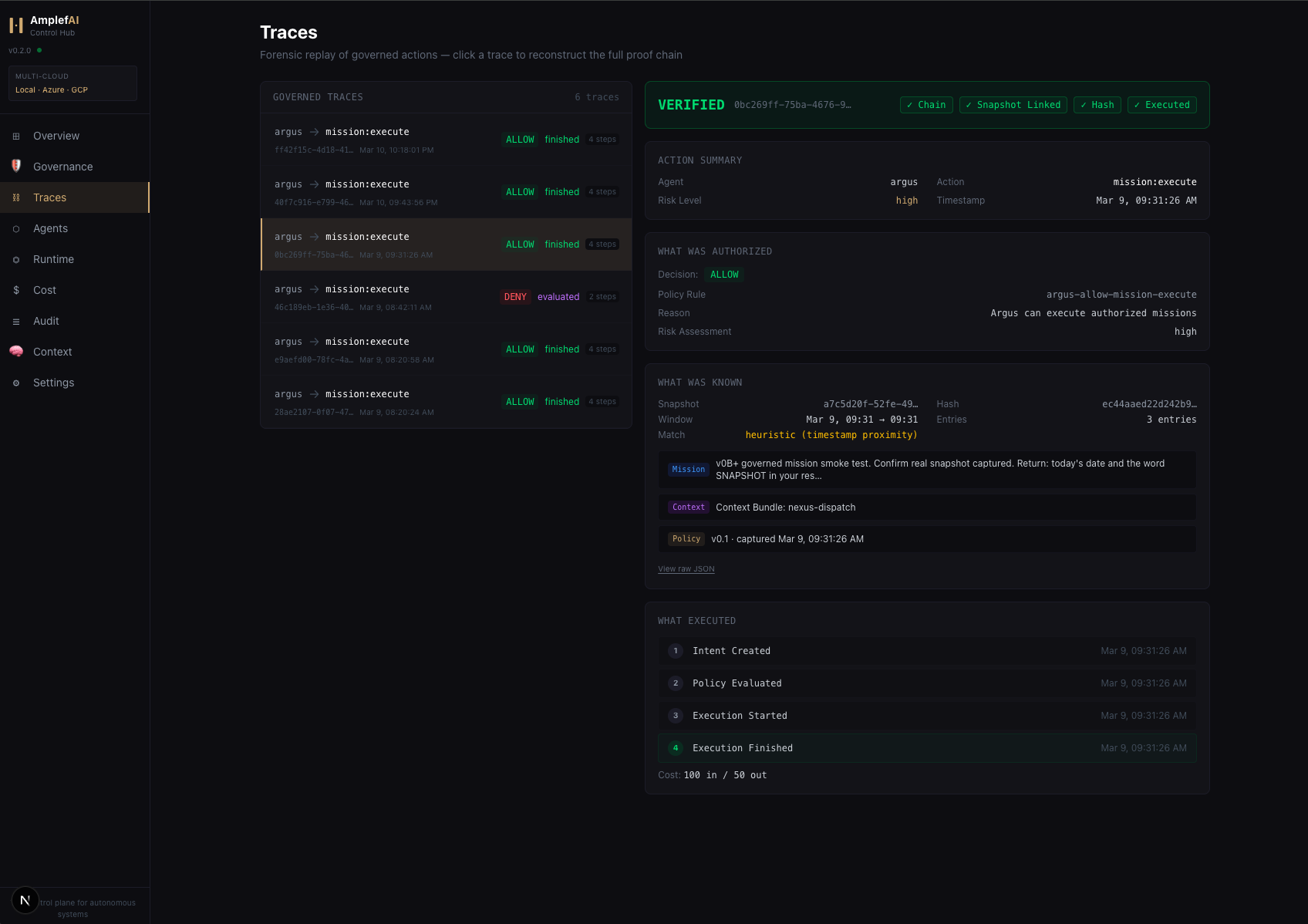
Governed actions, forensic replay, and verified traces. One control surface.
Enterprise Value
Three stakeholders.
One governance answer.
AmplefAI is easiest to adopt when security, compliance, and engineering can all verify the same control surface.
Agent actions are scoped, auditable, and bound to signed authorization. Policy enforcement lives in the governance layer, not in convention. The confidence to approve the next ten agents, not just the first.
Designed to support DORA traceability and defensible decision reconstruction. AI-specific regulation adds tailwind. Answer the auditor from the ledger, not from memory.
One evidence layer for every agent surface. Consistent APIs, unified observability, and less operational drift. Standardize once, then scale the fleet.
Why We Built This
We hit the limits ourselves.
Not capability limits. Accountability limits.
Our own AI agents were powerful, productive, and completely ungoverned. When we couldn't answer "what did the agent do at 2 AM, and who authorized it?", we knew this had to exist. So we built it. Not a diagram. A working spine, with a first replayable governed dispatch.
Let's talk.
Whether you're exploring AI governance, planning an enterprise pilot, or looking for a design partner, we'd love to hear from you.
In private preview. Building with design partners and early enterprise operators.
Your information is confidential and secure. We will never sell or misuse it.
Follow the thinking
We're building AI governance in public. New posts on architecture, enforcement, and what we're learning along the way.
No spam. Governance-grade email only.
Models will change. Agents will restart. Vendors will come and go. The question is whether your rules, your knowledge, and your audit trail survive the transition.
Change is inevitable.
Drift is optional.